


Contact for media
Pavla Grabowski
Senior Communications Specialist • Marketing & Communications, Corporate communications
press@skodagroup.com
27. 5. 2026
Škoda Group and rnv present the future of smart depots and intelligent urban mobility
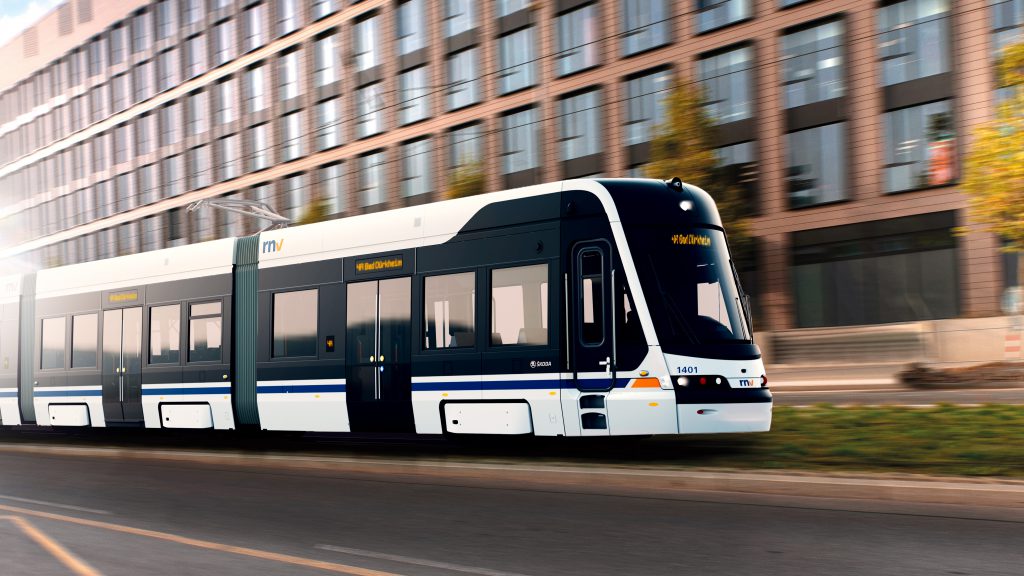
Škoda Group, a leading European manufacturer of zero-emission mobility solutions, together with the transport operator Rhein-Neckar-Verkehr GmbH, presented in Mannheim a comprehensive ecosystem of technologies for the automation, digitalisation and future autonomous operation of trams. The Autonomy Day event demonstrated the practical use of digital innovations directly in a real tram depot environment as well as on the urban network.
The programme included live demonstrations of autonomous tram movements within the depot, automatic parking, control of individual vehicle movements, obstacle handling in depot operations and automated passage through a washing facility. The system enables tram movements to be controlled via a central control system and demonstrates a further step towards the fully autonomous operation of urban rail transport.
Smart Depot as a technological hub of the future
One of the main highlights of the programme was the Smart Depot concept, which represents a key intermediate stage on the path towards fully autonomous tram transport on city streets. Škoda Group has been actively developing this concept for several years, drawing on experience from specific European projects, including Tampere, Finland, and the current technology presentation in Mannheim.
Smart Depot is based on an interconnected environment comprising three core areas:
- autonomous vehicle movement within the depot,
- digitalisation of operational processes,
- automation of service activities.
The individual modules are being developed so that they can be combined according to the specific needs of the customer, the operational model of the respective transport operator and the technical readiness of the infrastructure.
For Škoda Group, Smart Depot is a key technological hub where new technologies for modern urban mobility are created, tested and gradually brought to maturity. Thanks to a high degree of automation, it makes it possible to increase maintenance efficiency, optimise depot operations, reduce the volume of routine manual activities and provide operators with precise data for decision-making on vehicle operation and maintenance.
At the same time, Smart Depot creates an important bridge between today’s operation of urban rail transport and future full autonomy on city streets. The development of these technologies is therefore linked not only to technical testing, but also to the preparation of the future regulatory framework. In this area, Škoda Group is also actively involved in expert discussions on the future rules, standards and regulatory conditions that will be necessary for the safe introduction of autonomous functions into public transport.
ACS and ISL: intelligent safety systems for urban operation
Another part of the presentation programme focused on ACS (Anti-Collision System) and ISL (Intelligent Speed Limiter) technologies designed to increase the operational safety of trams. ACS helps prevent accidents or at least reduce their consequences. Its objective is to deal with emergency situations in a way that supports the driver without unnecessarily burdening them with false alarms.
ACS detects obstacles, evaluates the tram’s actual trajectory and can alert the driver to risk situations within its real driving corridor. As a result, it significantly reduces the number of false warnings even in dense urban traffic. Critical situations involving automatic emergency braking were also simulated here, and participants had the opportunity to experience them directly during a tram ride in regular urban traffic in Mannheim.
The system also works with the concept of a digital twin of the transport environment. In operation, ACS can generate data and heat maps of risk locations, which in the future will make it possible to better evaluate problematic sections, optimise traffic situations and plan safety measures more precisely across the urban network.
ISL technology uses vehicle localisation and knowledge of the infrastructure for speed limitation. For example, it helps prevent excessive speed when passing through curves, supports the driver when travelling on a new or less familiar route and adapts the vehicle’s behaviour to the specific section of infrastructure. In the event of driver inattention or incapacity, the system can respond and contribute to the safe handling of the situation.
Mobility Apps for fleet management, diagnostics and efficient operation
The so-called Mobility Apps, digital applications for fleet management, operational reporting, diagnostics and maintenance support, were also part of the presentation. Their purpose is to enable the transport operator to efficiently manage the movement of the entire fleet and control vehicle operation from a control room through specific missions and operational scenarios.
Fleet management makes it possible to plan and control vehicle movements within the depot and in subsequent operation, monitor vehicle availability and provide both dispatching and management with precise operational data. The solution includes reporting of key performance indicators for the operator, both in terms of operational parameters and financial efficiency. The data can also be integrated into ERP (Enterprise Resource Planning) systems and other tools used by the transport operator for planning, maintenance and the economic management of operations.
An important component of Mobility Apps is predictive diagnostics. It uses the vehicle’s digital twin, artificial intelligence and data collection from individual vehicles as well as the entire fleet. The systems work with a large number of diagnostic and operational data points and make it possible to predict emerging defects before component failure actually occurs.
Thanks to knowledge of service intervals, operational load and the current technical condition of the vehicle, the systems can recommend the appropriate moment for intervention so that the operator avoids an unplanned withdrawal of the vehicle from service due to one specific defect. Condition-Based Maintenance therefore makes it possible to plan maintenance according to the actual condition of vehicles, increase their availability and, at the same time, reduce total operating and maintenance costs.
The Škoda Group’s portfolio also includes visual inspection using AI, which enables automatic checks of selected vehicle parts, including pantographs, brakes and external components. The system can identify deformations, damage or unusual operating conditions and connects diagnostic data with image analysis.
Self-Surveillance: Active monitoring of the vehicle and its surroundings
A separate area of the presented technologies was active monitoring of the vehicle and its surroundings. Unlike traditional passive camera systems, this does not involve only image recording, but the intelligent real-time evaluation of risk situations.
Technologies using AI-based image processing directly on the vehicle enable, for example, the detection of people in hazardous zones around the vehicle, monitoring of the space between coupled vehicles, support for safe departure, monitoring of the depot area and automatic evaluation of non-standard situations. The system can actively alert the driver, dispatching centre or operating personnel to an emerging risk.
Self-Surveillance also contributes to improving passenger comfort and safety. Camera technologies can help prevent vandalism, evaluate situations inside the vehicle and monitor the area around the tram. If a person, obstacle or other object comes too close to the vehicle, the system can warn of this situation and support safe decision-making by the driver or operator. In relevant cases, the information can also be passed on to the dispatching centre or other authorities, such as the police.
Mannheim as a reference centre for smart mobility
The project will be followed by further development of cooperation in the fields of operational digitalisation, intelligent safety systems, diagnostics and the automation of urban mobility. Mannheim is thus becoming one of the reference locations for the presentation of Škoda Group’s future technologies in the field of smart mobility and modern tram systems.
“Mannheim represents an ideal environment for presenting modern technologies for urban mobility. Strategic collaboration with an innovative partner such as rnv allows us to test and deploy our technologies directly in real-world operations,” concludes Jiří Liberda, Managing Director Digital at Škoda Group.


