

Contact for media
Pavla Grabowski
Senior Communications Specialist • Marketing & Communications, Corporate communications
press@skodagroup.com
20. 1. 2026
“We have the largest volume of orders in our history,” says the head of the Plzeň-based Škoda Group.
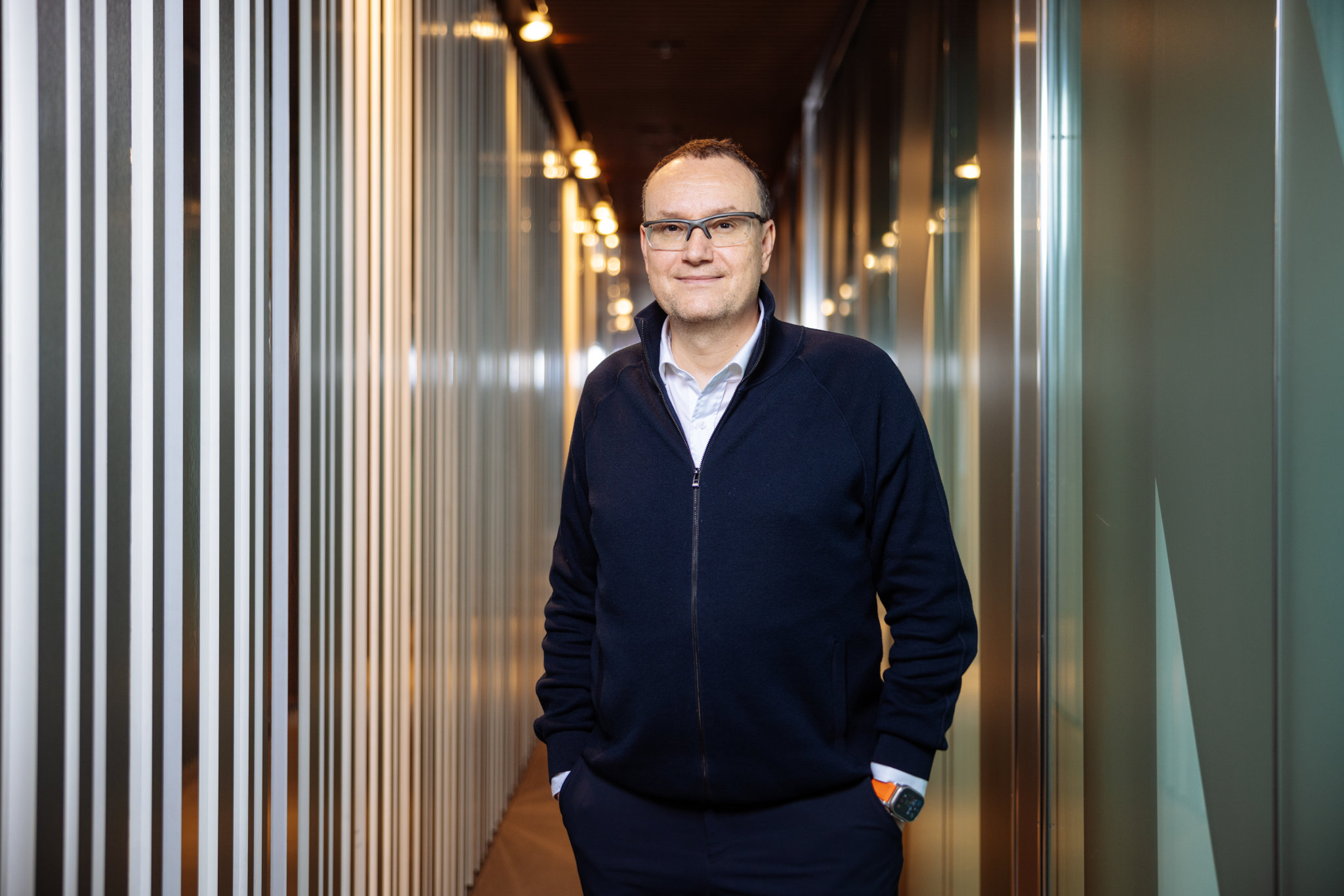
When Petr Novotný took over the leadership of Škoda Group nearly three years ago, the Plzeň-based manufacturer of trains and trams was not in the best shape. Customers were putting pressure on the company over delayed deliveries, and banks were also voicing concerns due to loans that had been provided. Novotný himself described 2023 as a “valley of tears” in an interview with Hospodářské noviny. The company’s loss at the time was around €100 million (2.5 billion Czech crowns), and to get through the worst period it needed help from the PPF Group of the Czech Republic’s richest woman, Renáta Kellnerová.
After two years in which everything at Škoda was focused on producing more efficiently, at lower cost, and with significantly higher margins, Novotný is now more optimistic. “The year 2025 was still partly about stabilization, but for the first time it was also significantly about development,” he said during an interview at PPF’s Prague headquarters in Dejvice.
Novotný considers the largest volume of orders in Škoda Group’s history a major success; new contracts amounted to CZK 38 billion in the past year alone. The most recent one was announced in December—a contract in Latvia for 16 battery electric multiple units (BEMU) worth €160 million, or just under CZK 4 billion.
This production will moreover deliver solid margins, and there is no risk of penalties for late deliveries, which the company had struggled with in the past. “We are producing on time, and after 2020 we managed to restore supply chains that were not functioning and were stalling,” Novotný highlighted. He also values the introduction of modular production and the ability to reuse some components—whether it is drives at Škoda Electric, which manufactures trolleybuses and electric buses, or brakes and control systems for trains and trams.
ROOM FOR HIGHER OUTPUT
From the perspective of its CEO, Škoda Group is simply in better shape. “The results have not yet been audited, but I can say that EBITDA will be significantly better—roughly double compared to 2024,” Novotný said. The year before last, operating profit before depreciation amounted to €62 million (about CZK 1.5 billion).
Things will also be brighter at PPF’s Dejvice headquarters. Within the group’s portfolio—alongside other investments in telecommunications, media, or banking—Škoda Group has not exactly shone so far. Its last larger profit (around CZK 4 billion) came in 2022, and only thanks to the one-off sale of the brand and the well-known winged-arrow logo, which Škoda Group may continue to use until 2029. The buyer was the Mladá Boleslav carmaker Škoda Auto.
This year, however, the company plans to repay PPF the money its owner injected into the engineering firm during 2023. “We have the ambition to repay this support in 2026,” Novotný confirmed.
Another positive for PPF is that after a wave of investments to expand production capacity amounting to €105 million (about CZK 2.6 billion), the company is invested for some time ahead. “We can increase production by 100 rail cars without major problems. We have sufficient free space as well as tools, equipment, and technologies,” Novotný said. In 2024, Škoda Group produced a total of 432 trams, trains, and trolleybuses. According to Novotný, further significant investment in production would only be required if output needed to rise by 200 cars per year.
WITH TRAMS INTO EUROPE
The optimism of Škoda Group’s chief is not based solely on better production organization, synergies, and improved material purchasing. According to Novotný, it is positive that the Plzeň-based manufacturer is not dependent on a single product and that its revenues come from new products developed by the company. There is thus effective linkage between sales and engineering.
In 2025, Škoda focused most strongly on trams. The company delivered 250 of them to German cities alone and also won a new tender in Mainz. In tram production, it is likewise striving for modularity in Plzeň and for reducing production from three types ideally to one, at most two types.
Novotný is duly proud of the quality of the new Plzeň trams: “I dare say we can be the best in the world,” he claims. An example is the new trams for Prague, which among other things feature swiveling bogies with gearboxes and are significantly quieter. Škoda would also like to succeed with this design in Bulgaria’s Sofia, Romania’s Bucharest, and in Poland.
The Czech manufacturer’s ambition is to break into Poland, where a strong domestic producer, Pesa, is active. There are at least 15 cities in the country whose transport companies operate trams. For Škoda Group, a key tram tender will be for the capital Warsaw, which the company will enter as soon as it is reissued. The Czech firm has already produced metro trains for the Polish capital, and in 2017 it even won a major tender for more than 200 trams. Ultimately, however, it was canceled due to a lack of financing.
Establishing itself in Poland is important for Novotný, and Škoda Group is taking steps to improve its chances. “In trams, we are targeting the creation of a center of excellence there—for service and development directly for the Polish market. We have also made it clear that we would like to cooperate with local players,” Novotný said.
A YEAR OF TRAINS AND THOUGHTS ABOUT BUSES
In 2026, by contrast, trains will be the company’s priority. Škoda Group has secured new contracts in the Czech Republic for three operators and is also successful abroad with electric trains. Novotný sees as a key achievement the design of a trainset for the operator Arriva capable of speeds of 200 km/h. “Thanks to this, we have moved a step further toward faster railways—before high-speed corridors are built. It is also important for the German and, more generally, the Western market,” he emphasized. The contract for Arriva covers 22 low-floor electric multiple units worth CZK 7 billion, with options for additional units.
Another promising product is the hybrid trains ordered by RegioJet, the carrier owned by entrepreneur Radim Jančura. RegioJet won a rail tender for northeastern Bohemia, where lines are not fully electrified. It ordered 34 hybrid trains from Škoda. The so-called BEDMU (Battery Electric Diesel Multiple Unit) have only five battery packs instead of the 12 used in fully electric units (BEMU), as well as a diesel generator that supplements the drive when the batteries are insufficient—that is, over distances exceeding 100 kilometers.
As for fully hydrogen-powered trains, which companies such as Siemens are experimenting with, Novotný remains skeptical for now. The high price of green hydrogen and problems with refueling, in his view, complicate the economics of their operation. His stance is supported by the recent decision of France’s Alstom, which has halted the development of hydrogen trains. Novotný does not write off hydrogen entirely, but believes it will not come into play before the 2040s.
The head of Škoda Group cannot hide the fact that he is someone with experience in the bus business. Before joining Plzeň, Novotný spent 14 years in various executive positions around the world at the Swedish bus and truck manufacturer Scania. The PPF Group also acquired a 50 percent stake in the Turkish bus manufacturer Temsa in 2020. According to Novotný, Škoda Group has ambitions to enter wheeled transport more significantly. “We are discussing the approach with shareholders. For now, in trolleybuses and buses we are more of a component supplier, even though they are under our brand,” he said.
WAITING FOR SUCCESS OUTSIDE EUROPE
Big things await Škoda Group on its domestic Czech–Slovak market, which accounts for roughly 35 percent of the company’s total revenue (in 2024, revenues reached €1.1 billion, or about CZK 27 billion). According to Novotný, the Plzeň-based manufacturer must maintain a significant market share there, as this is where it gains references and tests new products. In his view, as an employer of ten thousand people, Škoda should hold a position at home similar to that of Siemens in Germany or Alstom in France.
A so-called supertender for the Central Bohemian Region and Prague will be very important for Škoda Group. The company has been developing 22Ev electric multiple units for this tender for several years. “We are taking it very seriously. We have invested significantly in this solution. But I won’t be more specific,” he said when asked how damaging it would be if the winning operator did not choose Škoda as a supplier. The 30-year tender is being contested by České dráhy, RegioJet, and Arriva.
Despite the importance of the domestic market, Škoda Group primarily wants to strengthen exports. “We want to perceive all of Central Europe in a similar way to the Czech and Slovak markets. We consider Poland and Germany our home markets, as well as the Balkans and the Baltics,” Novotný said. Looking ahead, he also sees Ukraine as important. Beyond these markets, Škoda is interested in France, for example in a contract for the Eurotunnel. It wants to expand its market share in Italy and maintain it in Scandinavia, where it operates a plant in Otanmäki, Finland, under the name Škoda Transtech. That is why the company is resisting exclusion from the tender for trams in Helsinki. By contrast, last year it succeeded in winning a metro contract in Stockholm, Sweden.
Outside Europe, Uzbekistan is currently the number-one destination for the Plzeň-based company. This is reflected in the amount of time Novotný devotes to the Central Asian country—he has visited it several times over the past year. The reason is a contract for 30 trains, with a possible expansion to as many as 100 units. Škoda Group already succeeded in the Uzbek tender two years ago, but everything collapsed due to export financing, which, as Novotný admits, was not ideally prepared on Škoda’s side. With the help of the state insurer EGAP and the European Commission and its Global Gateway program, the chances of winning the contract have now increased, as the company has put forward an offer capable of competing with Chinese suppliers.
“After two years of negotiations, we managed to combine EU and Czech support to present the government of Uzbekistan with a comprehensive offer. Thanks to that, the solution is very realistic,” Novotný believes. If Škoda Group succeeds in the country, it does not want to stop there and plans to create a hub for the whole of Central Asia.
A potentially multi-billion-euro market is opening up to Škoda Group in India, where last year it formed a joint venture with the local industrial giant Tata Group to manufacture train components. India, with its billion-strong population—where other Czech companies such as Bonatrans, Promet, and AMiT also operate—could be very interesting for Škoda. At the beginning, however, much depends on the support of Tata, which is a key domestic partner for launching the joint venture.
In Plzeň, the company is also keeping an eye on the United States. Here, too, however, it would only be about supplying components, and according to Novotný such a step would only be considered if Škoda partnered with an American company.
ACQUISITIONS OR ORGANIC GROWTH?
Last year was also a period in which Škoda Group sought a merger with the Spanish manufacturer Talgo. This made sense, as Talgo produces high-speed trains and is very strong in Southern European and Arab markets. However, the Spanish government pushed for the key company to be taken over by a domestic firm. That ultimately happened, and shortly before Christmas the company was acquired by a consortium led by private equity firm Ekarpen with the support of the state industrial holding SEPI. Nevertheless, Novotný still sees some opportunity with Talgo. “I believe that cooperation in terms of production capacities is still possible,” he said.
When asked by HN whether Škoda Group is still considering acquisitions, Novotný was cautious. He sees organic growth and cooperation as a better path. These are advantageous, for example, in increasing the volume of tenders that Škoda Group can enter. Novotný also does not want to commit to any permanent strategic partnership. He considers project-level cooperation ideal, such as with Germany’s Siemens on the ComfortJet railcar for České dráhy or on the contract for Prague’s Metro Line D.
However, the CEO of Škoda Group sees great potential elsewhere. “A certain level of cooperation in platform development is desirable even among competitors, similar to what has happened in the automotive industry,” he explained. An example is cooperation between Mercedes, Scania, and Volvo in engineering individual platforms. This trio of European manufacturers competes more effectively with non-European firms and also has greater purchasing power for materials and components. Similar cooperation would also reduce pressure on spending for development and innovation, which at Škoda Group averages €90 million per year (about CZK 2.2 billion).
FINANCING MUST BE SUSTAINABLE
Cost savings that allow offers to be priced more competitively will be important going forward, according to Novotný. EU rail subsidies—whether from the Connecting Europe Facility (CEF), loans from the European Investment Bank, or national support schemes—have their limits. At the same time, the need to renew rolling stock is not diminishing. In Novotný’s view, banks, manufacturers, and leasing companies must change their perspective on financing these investments, which amount to tens or even hundreds of billions of crowns.
“Long-term financing of these projects must be resolved—not only during the implementation phase, which can last three years, but also during operation itself, which can span up to 30 years,” Novotný believes. According to him, banks must accept a 30-year contract of an operator that has secured a per-kilometer price through a tender as collateral for a loan. At the same time, they should take into account that a train is an asset depreciated over three decades. Such a train can operate anywhere, not only on the tendered route, which in Novotný’s view provides additional risk mitigation for financing banks.
The interview was published in Hospodářské noviny and was written by Petr Zenkler.